 Known as “La Isla de la Munecas”, by the Spanish, The Island of the Dolls is perhaps the creepiest tourist attraction in Mexico. Located within an extensive network of canals, south of Mexico City, the island is a place of mystery and superstition.
Almost every tree growing on the island is decorated with old, mutilated dolls that give anyone the feeling that they’re constantly being watched. The story behind the Island of the Dolls began when a hermit by the name of Don Julian Santana moved here. Although he was married he chose to live the last 50 years of his life alone.
Don Julian used to say he was haunted by the ghost of the little girl who had drowned in one of the canals around the island. Some say he used to fish the dolls from the water because he though they were real children, but the truth is he was collecting and placing them around his home as a shrine for the spirit that tormented him. At one point he even traded home grown fruit and vegetables for old dolls.
Ironically, in 2001 Don Julian Santana was found dead by his nephew, in the same canal that he said the little girl drowned in. Now his Island of the Dolls is one of the world’s weirdest tourist attractions. Some tourists who visited this place claim the dolls whisper and you must offer them a gift upon setting foot on the island, to appease their spirits.


The world's longest traffic jam was 110 miles (176 kilometers) long, between Paris and Lyon on the French Autoroute in 1980.

A 60-mile-long traffic jam on a major Beijing highway has lasted more than nine days, with stranded drivers taking to playing chess on their cars as local vendors organize roadside shops like in a Cortázar short story. What's causing this potentially month-long jam? In short, increased traffic on the highway mixed with maintenance and construction. Britain's Sky News reported the snarls have been commonplace since May as a result of a spike in the number of trucks using the roads, with the daily peak reaching about 17,000. In this specific case, cars and trucks have been piling up since August 14, 2010 on the National Expressway 100, which is also known as the G110, the major route from Beijing to Zhangjiakou.

Another picture of Sao Paulo, at the intersection of Faria Lima and Juscelino Kubischek Avenue.
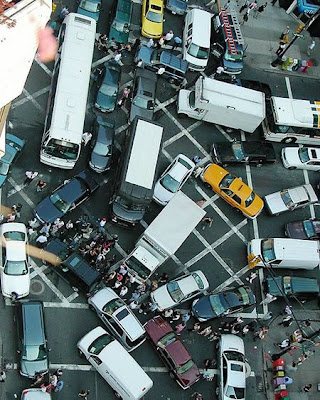
Gridlock resulting from vehicles and pedestrians "blocking the box" at the intersection of 1st Avenue and 57th Street in New York City.

Traffic congestion caused by people fleeing from Houston, Texas, due to Hurricane Rita in 2005. Evacuees used Interstate 45 which was/is an official evacuation route.

Car and Motorcycle jam in Taipei.
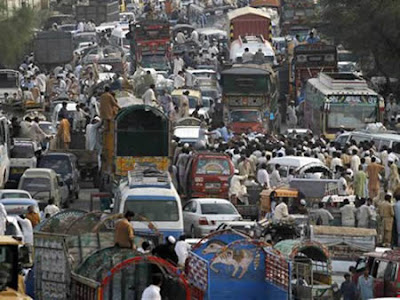
Vehicles are stuck in a traffic jam caused by a demonstration held by flood-affected people demanding that the government provide aid to flood victims in Nowshera, Pakistan.

Traffic jam caused by the celebration of the Diwali in North India.

Patna witnessed unprecedented traffic jam in December 1, 2009, following protest rallies taken out by different organizations in support of their demands. Throughout the day, traffic chaos ruled all the roads giving a tough time for commuters.
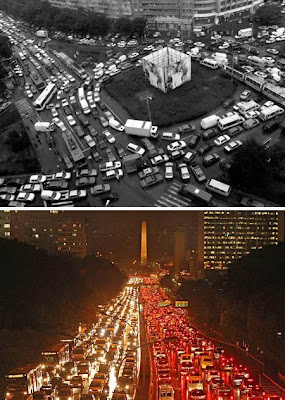
A traffic jam in Sao Paulo, Brazil. In June 2009, Sao Paulo set a new record for bad traffic, 295km of traffic jam accumulated throughout the entire city, meaning over 35% of the city's roads.
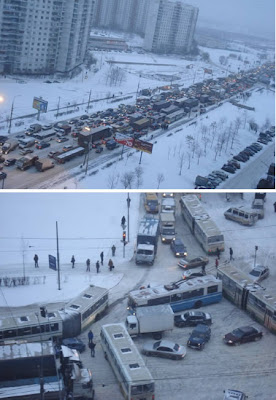
Frozen Traffic Jam in Moscow.

Moscow also has different reasons for traffic jams. One of them is frosty severe winter. Transportation roads cannot work well because of black ice. The other problem is high quantity of life and, as aresult, possession of many vehicles. And apparently, some streets must be reconstructed and broadened.
Source
World's Most Crowded Wave Pool (Tokyo Summerland, Japan)
Don't believe the photo above? This incredibly crowded wave pool is located in Tokyo Summerland. During the summer, it can get really hard to actually find some water inside the pool.
World's Most Crowded Prison (Kresty Prison, St. Petersburg, Russia)

Russia's prisons have a reputation for being the most overcrowded on Earth, especially Kresty Prison in St. Petersburg. The official capacity is set at 3,000, but the actual population is always at least 10,000. Each prisoner is also said to only be allowed 4 square meters of space each and 15 minutes a week (a week!) to shower. In summer 2006 Vladimir Putin announced that the prison would be relocated to a new facility in the Kolpinsky District on the outskirts of Saint Petersburg. After the relocation is complete the Kresty building will be sold at auction. It is anticipated that the prison building will be transferred into a hotel-entertainment complex.
World's Most Crowded Street (Shibuya, Tokyo, Japan)

With 2.5 million people a day, there's no doubt Tokyo's Shibuya is the busiest intersection in the world. No matter what time you go, the crossing is always busy. During the day, in the middle of night, at dusk – the amount of people is always consistent. It must be quite exciting when the green light goes on and you see the thousands moving in your direction.
Europe's Most Crowded Country (England)

The number of people living in England has overtaken the population density of Holland, which has traditionally been the most densely-populated major nation on the continent. The count, which has been attributed to higher levels of immigration, shows England has 395 people per square kilometre. China is still the most crowded country in the world.
World's Most Crowded Area (Mongkok, China)
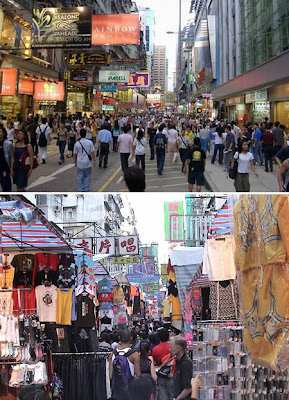
According to Guinness World Records, the Mongkok area has the highest population density of anywhere on Earth, with an estimated 130,000 people per square kilometer. Mongkok is a commercial/residential area located in central Kowloon. The Chinese characters for Mongkok (“旺角”) mean “busy corner” and this too is no exaggeration.
World's Most Crowded Beach (Qingdao Huiquan Beach, China)

Reputed to be the largest sandy beach in Asia, the number one bathing beach is situated on Huiquan Bay in Qingdao, Shandong Province. Also called Huiquan Bathing Beach, this beach is noted for its clear water, mild waves and soft sand. Even in winter this place is crowded with keen swimmers.
World's Most Crowded Subway Station (Moscow, Russia)

This image was taken in a typical day in a Moscow's city subway. Not every station is like this but there are some narrow places so when the peak traffic happens people have to move like that.
World's Most Crowded Train (India)
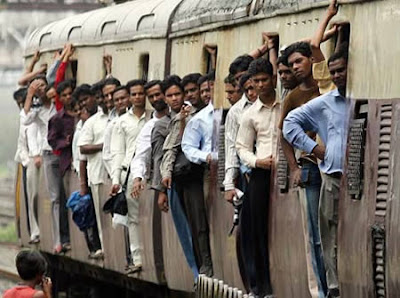
A lot of people assume that Japan has the world's most crowded trains. Apparently that's not the case. On an episode of a Japanese TV show, “Itte Q,” a reporter was sent to India so she could experience what may be the “world's most crowded train”. They wanted to see if she could read a newspaper on the train, but it proved to be extremely difficult.
World's Most Crowded Football Stadium (Rio de Janeiro, Brazil)
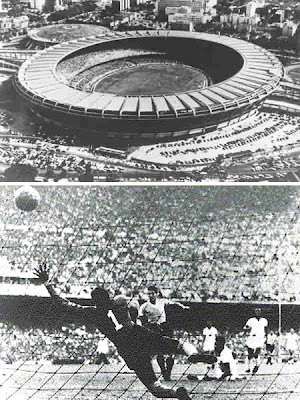
Open-air stadium Maracanã, officially known as the Estádio Jornalista Mário Filho in Rio de Janeiro, Brazil, opened in 1950 to host the FIFA World Cup. During the last game of this cup, in a match that would be later known as the Maracanazo, a world record of attendance was set in a football game: the official number of viewers was 199,854, with the actual attendance estimated to be about 210,000.
Source
Ronnie Coleman: eight straight wins as Mr. Olympia
Born May 13, 1964 in Bastrop, Louisiana, Coleman is a retired American professional bodybuilder who shares the record of eight straight wins as Mr. Olympia. He also holds the record for most wins as an IFBB professional with 26 wins. Coleman graduated Cum Laude from Grambling State University with a degree in accounting.
Lou Ferrigno: the Incredible Hulk
Known for being long time bodybuilding rival of Arnold Schwarzenegger and the original Hulk on the TV show, Lou Ferrigno was also a deputy sheriff. After graduating from Brooklyn Technical High School in 1969, Ferrigno won his first major titles, IFBB Mr. America and Mr. Universe, four years later. In 1974, he came in second on his first attempt at the Mr. Olympia competition. He then came third the following year, and his attempt to beat Arnold Schwarzenegger was the subject of the 1975 documentary Pumping Iron. Following this, Ferrigno left the competition circuit for many years, and went for his acting career.
Johnnie O. Jackson: notable powerlifter
As you can see, Johnnie O. Jackson may not be the biggest bodybuilder around, but the thickness and density of his muscles are mind blowing. They pop out and he isn't even flexing them. Just sitting relaxed. He won the 2006 Montreal Pro, 2001 NPC USA Championships, among others.
Markus Rühl: some of the biggest shoulders in history
Well known for his freakish size, german Markus Rühl is a former IFBB professional bodybuilder. He possesses some of the biggest shoulders in bodybuilding history, and is one of the strongest bodybuilders alive along with Johnnie O. Jackson and Ronnie Coleman.
Arnold Schwarzenegger: youngest Mr. Universe at age 20, then won Mr. Olympia seven times
Before becoming a famous actor and a controversial politician, Schwarzenegger was considered to be one of the greatest and most influential names in the field of body building to this day. Schwarzenegger began weight-training at 15 and became the youngest Mr. Universe at age 20 and going on to win Mr. Olympia a total of seven times. Schwarzenegger has remained a prominent face in thebodybuilding sport long after his retirement, and has written several books and numerous articles on the sport.
Gregg Valentino: World's Biggest Biceps

Gregg Valentino is one of the most controversial yet popular bodybuilding icons. He started bodybuilding at the age of 13. After over 23 years of training naturally Gregg decided to experiment with steroids. During this time his arms grew from an impressive 100% natural 21" to an in-human 28". But after years of steroids injections, his body finally fought back: his bicep "exploded," as the video below explains:
Source
Al illusion have always fascinated mankind since they were first discovered, raising important questions about the way our brain works. The following optical illusions will definitely test your imagination and observational skills to the max so test yourself to see how you perform.
Despite of many years of research the human brain still has a lot of mysteries that are yet to be uncovered. The way our brain perceives reality is a subject that was debated for a long time and the answers are still pretty vague. Although it might be tempting to believe that what we see and what our minds perceives is identical some of the following optical illusions might make us change our mind. A first example is the default picture where it might seem that there are two triangles but in fact only one triangle was drawn. This illusion is known as the Kanizsa Triangle. Here are some other intriguing optical illusions:
Fraser Spiral Illusion
This famous illusion is known as the twisted cord or false spiral illusion. The contrasts in this picture give the impression of a spiral however, this ''spiral'' is actually a simple series of concentric circles that has the power to trick our brain due to the contrasts formed.

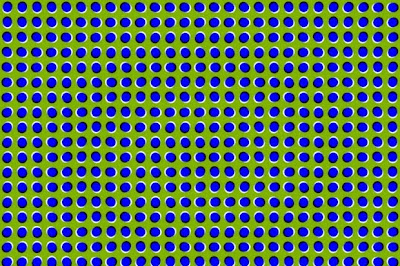
The moving image illusion
Sometimes the contrasting colors and the placement of a certain elements can trick our brain into thinking that some images are moving when in fact they are static. This is exactly the case with the following image.
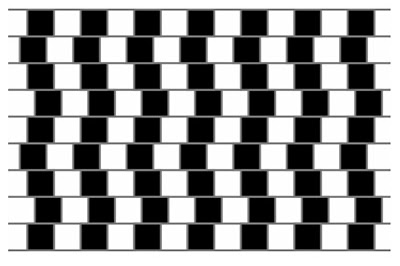
Cafe wall
Another classical optical illusion is the cafe wall, which was first discovered by doctor Richard Gregory. In this illusion although the lines appear to be bent they are actually perfectly straight and actually parallel. Just take a closer look at the picture and you'll immediately see this.
The Hermann Grind
This illusion first discovered in 1870 is characterized by the “ghostlike” intermittent appearance of lightly colored gray dots that seem to connect the white surfaces and the black background. However, once we take a closer look the dots “magically” disappear. This illusion can be explained by a dissonance that takes place in the receptive field of the brain.

Pictographic ambiguity
Nowadays there are a multitude of illusions based on this concept. Photographic ambiguity tests your imagination as well as your observational skills by placing different images that can be perceived by looking from different angles. Can you spot both the young lady and the older one?
Having trouble figuring this one out? here's a little clue to make things easier: the chin of the young lady actually forms the nose of the old lady.

If this one seemed way too obvious for you here's something a little more challenging that will really test your observational skills. Can you find the hidden tiger in this picture?
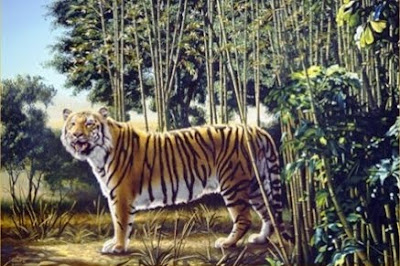
This painting is might seem like nothing more than a wonderful landscape painting but the this apparently ordinary nature representation holds many secrets that cannot be uncovered at a superficial glance.
In fact the picture has a multitude of hidden portraits all over if you just know how to look. While most people claim that there are 13 faces some claim they have found over 21! How many can you spot?







 Like many young geeks, when I was a kid I wanted to be an archaeologist–and a paleontologist–when I grew up. Nothing sounded so exciting as discovering ancient cities, unearthing forgotten cultures, and also, if I had the time, naming a dinosaur after myself. Well, I eventually found other career paths, but I still love history and am always on the lookout for neat news in archaeology. This morning, I was not disappointed.
New archaeological research is changing the way we view our past. According to researchers in Egypt, it appears that the Pyramids might not have been built the way we thought. And no, I’m not talking about alien architecture here.
Since the 1990s, archaeologists have been working on an area near the great pyramids and now believe they have unearthed the tombs of the paid laborers behind one of the world’s most awe-inspiring constructions. For centuries, it’s been understood that slaves were behind the pyramids, but experts challenge that with these new discoveries, which date from the 4th Dynasty, or 2575 B.C. to 2467 B.C.
A few things that archaeologists have discovered include some surprising details. For instance, Zahi Hawass, the head of Egypt’s Supreme Council of Antiquities, believes that there were approximately 10,000 laborers working on the construction of the great pyramids. It also took 21 cattle and 23 sheep a day to feed them. Hawass explains: “These tombs were built beside the king’s pyramid, which indicates that these people were not by any means slaves. If they were slaves, they would not have been able to build their tombs beside their king’s.”
In addition, is appears that laborers only worked for three months out of the year, then being rotated out of the job. Hawass also believes that the individuals buried in the tombs are laborers who died during their term as builders.
Salima Ikram, professor of Egyptology at American University in Cairo, put the discovery in perspective: “It is important to find tombs that belong to lower class people that are not made out of stone that tell you about the social organization and the relative wealth of a range of people.”
Source
